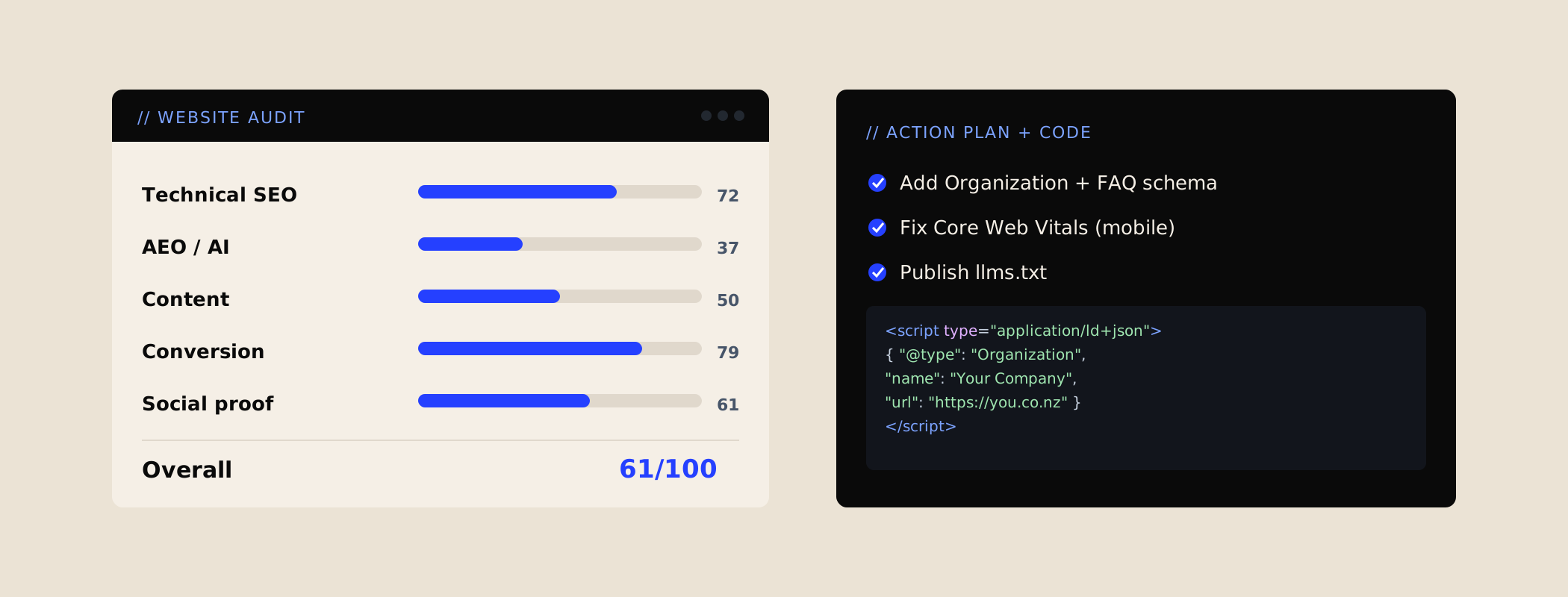

I price the output, not the hours. Every quote I send says three things: what you get, how long it takes, and a fixed price. There is an hours guide on it so you can sanity-check the number, but it is a guide, not a meter. If the work takes longer, that is my problem, not a surprise invoice.
The problem with hourly agency invoices
Hourly billing rewards the supplier for taking longer. That is not a moral failing, it is just the incentive. If the agency spends six hours working out why your sitemap is broken, you pay for six hours. If they spend two, you pay for two. Either way, you are paying for the learning curve, not the fix.
It also makes the invoice impossible to judge. "14.5 hours - technical SEO" tells you nothing about what changed on your site. You cannot compare it to another quote, and you cannot tell whether it was a good month or a slow one.
And it creates the worst moment in any engagement: the invoice that is bigger than expected, with a line that says "additional time required." Nobody signed up for that.
What output-based pricing means
Output-based pricing means you pay a fixed price for a defined set of deliverables. Every quote I send has the same three parts:
- What you get. The specific deliverables, listed. Not "SEO support". Things like "redirects mapped and live" or "Organization and FAQ schema on every key page".
- How long it takes. A realistic timeframe, like "foundations finished in roughly 1–2 months".
- The price. Fixed. It covers the scope, not a timesheet.
I still show an hours guide, for example "roughly 10 hours a month of my time". That is there so you can check the number against what you would pay elsewhere. It is not a meter running in the background.
A worked example: the Foundations quote
Here is what a typical Foundations quote looks like. It starts from NZ$1,400 a month, with an hours guide of about 10 hours a month.
What you get, months 1–2 (foundations finished in roughly 1–2 months):
- Redirects, sitemap, robots.txt, canonicals and indexing fixes
- Titles, meta descriptions and H1s for every key page
- Organization, Product, Article and FAQ schema
- llms.txt and AI-crawler access
- Entity consistency across your site, LinkedIn and directories
- GA4, Search Console, Bing Webmaster Tools and conversion tracking
- A priority keyword list and an AI-visibility baseline
- A recheck of everything shipped
What you get from month 3: content that gets cited - comparison pages, guides and FAQs - at two long-form pieces a month, plus a monthly report in plain English.
Terms: the foundations are usually done in one to two months. Prepay six or twelve months and it is 10% off. If you want me to make the changes in your CMS instead of handing over instructions, hands-on implementation is +NZ$500 a month on any tier. The full tier list is on the pricing page, and there is more detail on each in what's in a Cut the Waffle package.
Why two very different sites can cost the same
Every client gets the same end result: technical SEO foundations fixed, AI signals in place (schema, llms.txt, entity consistency, AI-crawler access), tracking set up, and content that gets cited. What changes is the effort to get there, and the price follows the effort.
Three things move it: site size, platform, and who implements.
Platform is the one people underestimate. Take two sites:
- A 300-page Webflow site. Ten times the pages. But alt text, CMS fields and meta edits can be automated through the Webflow API. Hundreds of fixes go out as one scripted, checked batch.
- A 30-page custom-built site. Far smaller. But every title, every schema block and every redirect is a manual edit, often through a developer.
Those two can land at a similar price for similar effort. Page count alone is a bad way to quote. That is why every engagement is scoped properly first - usually off a website audit - before a number goes on paper.
Why it costs less than an agency
Not because the work is lighter. The end state is the same one a good agency would aim for.
The difference is where the time goes. I run a detailed context system: a base methodology plus context files for each client. AI does the research, audit crawling and checklist generation against a model I have defined. What comes out is a clear, ordered list of things to fix.
So paid time goes on doing, not on learning and figuring out. Agencies bill the figuring out. Hourly billing is what lets them. I wrote about why this works in AI context, not prompts - it is the same idea, applied to my own business.
If you want to compare that against the wider market, the bands are in how much B2B SEO costs in NZ.
What I commit to
A fixed price only works if the person setting it is straight with you. So these are written into how I work:
- I will tell you if it is not worth doing. If the numbers do not stack up for your business, you will hear that before you hear a quote.
- The hours guide is always shown. You can see roughly how much of my time the price buys.
- No surprise invoices. If the agreed scope takes longer than the guide, that is on me.
- Out-of-scope work is quoted first. NZ$150 an hour, agreed in writing before anything starts. Never added after the fact.
- You own everything. Content, schema, documentation and access stay yours if we stop.
More on the first few weeks of an engagement is in how I work with new customers.
Where this fits: Prices for all of this are on the pricing page: two retainers, Foundations from NZ$1,400 a month and Content & Enablement from NZ$2,500, plus fixed-price projects. The whole method, step by step, is in the AI Search Playbook.