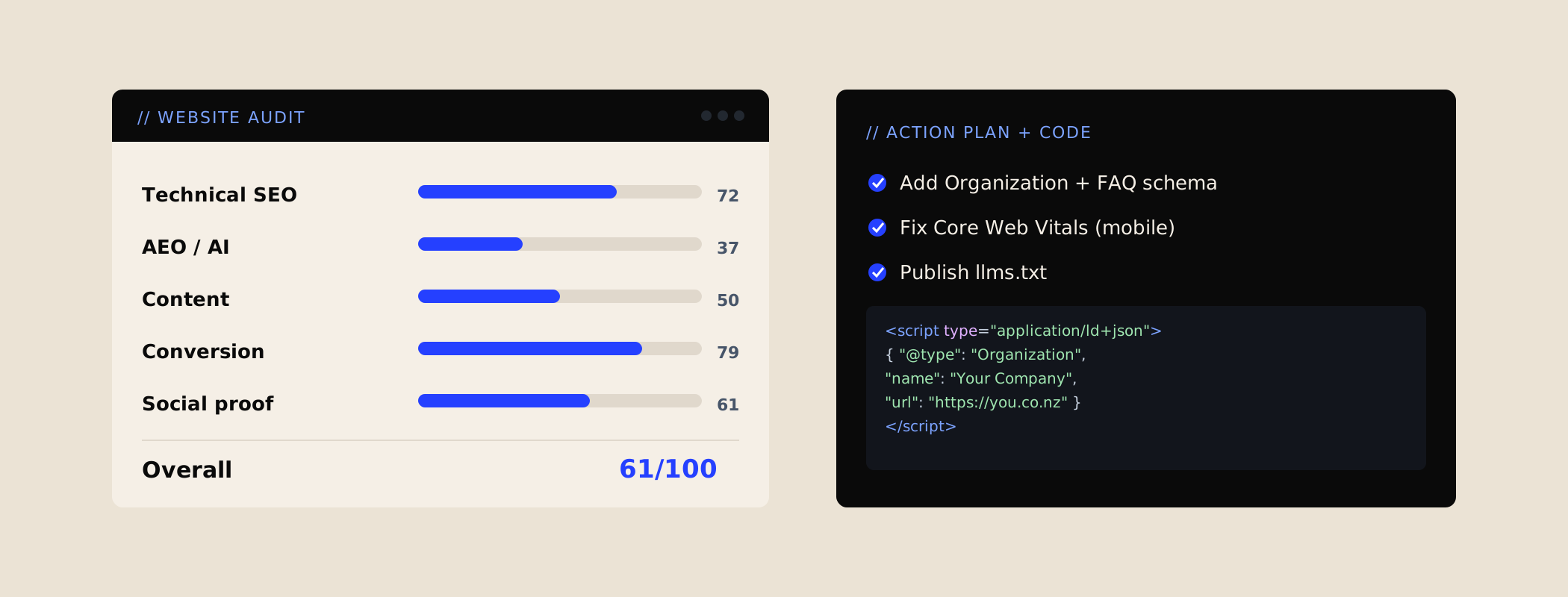
Most B2B sites I audit have the same problem. The content is fine. The product is good. But the site underneath is leaking: no structured data, missing H1s, duplicate titles, old pages in the sitemap, and facts that contradict each other. Google and AI assistants read all of that, decide the site is not a reliable source, and quote someone else. Foundations is the work that fixes it.
It's common, even among the people who sell this. In my check of 80 NZ and AU agency websites, only 5 had all 12 basic AI-search foundations on their own homepage.
Why foundations come first
AI assistants and Google are both trying to answer one question about your site: can I trust this as a source? They decide that from signals you might never look at. Is there structured data saying who you are? Does every page have one clear heading? Do your facts match what LinkedIn, directories and your own other pages say? Is the sitemap full of junk?
When those signals are messy, it does not matter how good the next blog post is. It gets judged on the same broken foundations. Fix them once, and every page you publish afterwards works harder.
Month 1: technical foundations
- Redirects, sitemap, robots.txt and canonicals, so Google indexes the right version of every page and drops the junk.
- New titles, meta descriptions and H1s for every key page, written around what buyers actually ask Google and AI.
- Schema markup: Organization and WebSite sitewide, then Product, Article, FAQ and Person where they fit, all linked into one connected graph.
- llms.txt and AI crawler access, so the AI bots are let in and given a clean summary of who you are.
- GA4, Search Console and conversion tracking, so you can see what is working.
- A priority keyword list, tiered by what is realistic in 3, 6 and 12 months.
- An AI visibility baseline: 20 to 30 real buyer questions run through ChatGPT, Google's AI, Copilot and Perplexity, logging who gets named and who gets cited.
Month 2: pages, facts and entity fixes
- Key pages rebuilt to be quoted: product, pricing, location or use-case pages with a direct answer up top, a spec table where it helps, and schema.
- A fact and claims pass: one version of every number on the site (years in business, customer counts, test results), each claim linked to its source. Contradictions are one of the fastest ways to lose AI trust.
- Entity fixes: Wikidata, LinkedIn, directories and review sites all describing you the same way and pointing at the right website.
- Image alt text and performance fixes for the pages that matter.
- A re-check of everything from month 1, plus a short report on what moved.
Month 3 onwards: content AI quotes
Once the site is readable, content starts: two long-form pieces a month. I usually start with comparison pages, because they are the most-cited content I have seen in AI answers, then buyer guides and use-case pages. Each piece arrives ready to publish: H1, meta, body, FAQ, internal links and schema.
Each month also includes a short report: Search Console movement on your priority terms, the AI visibility panel re-run against the baseline, and leads by source.
What it costs and how it works
| Item | Detail |
|---|---|
| Price | From NZ$1,400 a month. |
| Effort | About 10 hours a month, as a guide, not a meter. |
| Timeline | Foundations done in roughly one to two months, then ongoing content and AI visibility tracking. |
| Who implements | Everything arrives ready to paste for your team or developer. Or add hands-on implementation, where I make the changes in your CMS, for NZ$500 a month. |
| One-off option | For larger sites or teams that only want the fix, I also run it as a fixed-price sprint. |
Full details are on the pricing page.
What to expect at the end
Be wary of anyone promising AI citations by a date. What you can expect is that the technical work ships fast, usually in the first few weeks, and that you can see it move. Live-search citations often start to shift within weeks of the fixes going live. Training-data citations take months, because they only change when the models are retrained. I cover the timeline properly in how long AEO takes.
At the end of the foundations you should have a site Google and AI can read, a baseline to measure against, every change written down (so it survives a replatform), and a clear content plan for what comes next.
Where this fits: this is the AEO foundations work. What comes after it is content for AI search and sales.