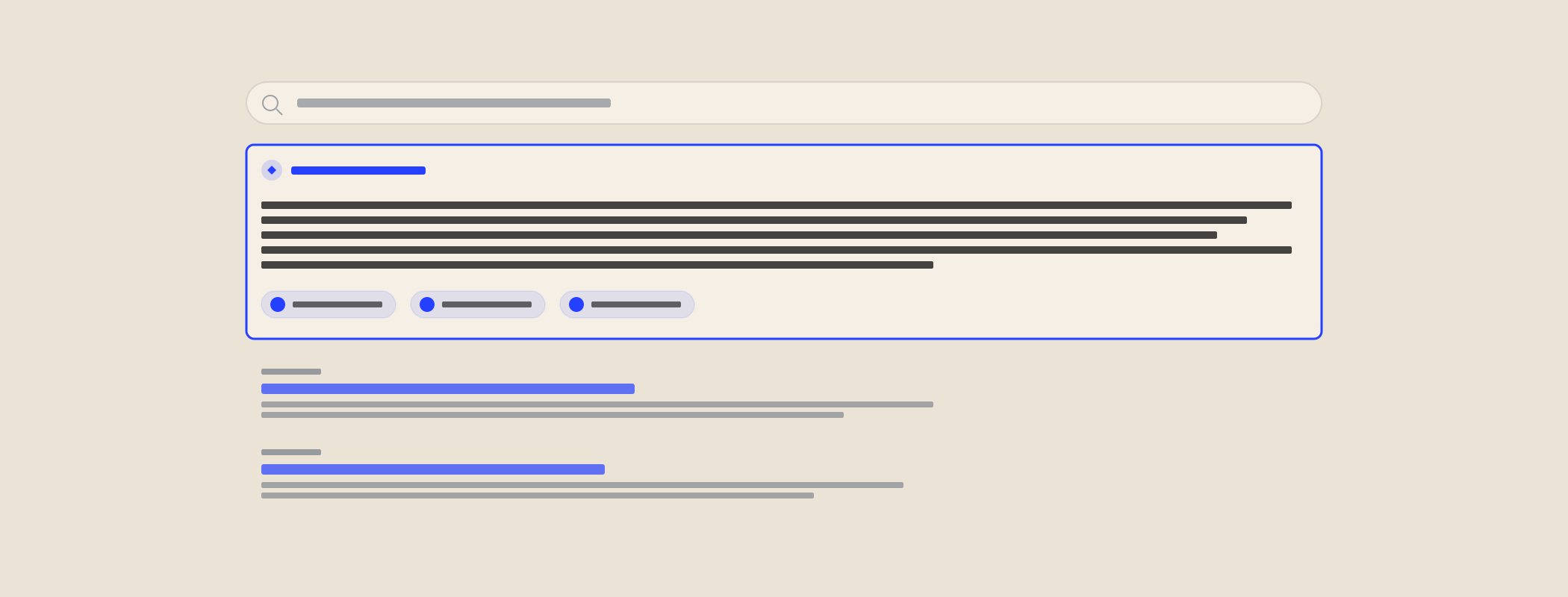
You search your own category. Google's AI Overview at the top of the SERP names three brands. None of them are you. Worse - you've ranked in the top 5 organic for years. So why is the AI ignoring you? Here's the diagnostic walkthrough, the 5 fixes in priority order, and a realistic view of how long each takes to bite.
Why this happens to brands that already rank in Google
Google's AI Overviews don't simply summarise the top 10 organic results. They blend three signals:
- Organic ranking - yes, the top results matter, but they're not the only source.
- Content structure - pages with clear Q&A, direct answers, and FAQ schema are heavily preferred for AI Overview citations.
- Entity trust - Google's knowledge graph cross-checks your brand against external sources (LinkedIn, Wikipedia, G2, industry press) before citing.
You can rank #2 organic and still be invisible to AI Overviews if your content is keyword-optimised rather than question-structured. The Overview doesn't want a 2,000-word essay. It wants a clean answer it can quote.
Fix 1: Schema markup (2–4 weeks to bite)
This is the fastest, cheapest, and most underused fix. AI Overviews preferentially cite content with FAQPage, Article, and Organisation schema. If your pages don't have these - or have them but they're broken - you're competing with one hand tied.
The minimum: FAQPage schema on your homepage and top 5 service pages, Article schema on every blog post, Organisation schema sitewide. Full schema walkthrough here.
Validate with Schema.org validator and Google's Rich Results Test. Don't trust your CMS dashboard - trust the validators.
Properly implemented FAQPage schema typically shifts AI Overview citation behaviour within 2–4 weeks. It's the single most cost-effective AEO move available.
Fix 2: Content structure (4–8 weeks to bite)
AI Overviews quote content that's structured like an answer. Most B2B content is structured like a sales pitch. The fix:
- Lead every section with the answer. First sentence answers the question. Don't build to it.
- Make H2s and H3s specific. "How AEO pricing works" beats "Pricing" every time. The AI uses heading text as citation hooks.
- Add Q&A blocks. Even a 200-word section in a 1,500-word post that's structured as a clear Q&A gets cited disproportionately.
- Cut filler openers. "In today's fast-paced digital landscape" tells the AI exactly nothing.
- Use short paragraphs. 2–3 sentence paragraphs are easier for AI to extract as citations than 7-sentence walls.
Restructure your top 10 pages first. Don't try to rewrite the whole site.
Fix 3: Entity consistency (6–12 weeks to bite)
Google's knowledge graph triangulates your brand from external sources before citing it. Inconsistent descriptions across your website, LinkedIn, G2, Crunchbase, partner directories, and press coverage reduce confidence and reduce citations.
The audit:
- Pull your descriptions from your website, LinkedIn company page, G2 / Capterra profile, Crunchbase, partner pages, and any press mentions.
- Find the discrepancies. They're usually subtle - slightly different one-liners, different founding dates, different service descriptions.
- Pick a canonical description and propagate it everywhere you control. Use the same elevator pitch. Same founder bio. Same service taxonomy.
- For sources you don't control (press, third-party listings), reach out and request updates where the description is materially wrong.
Fix 4: Original data and citable assets (3–6 months to bite)
AI Overviews preferentially cite original data over recycled commentary. If you publish a piece of research, a benchmark, a survey, or even a well-structured comparison table, you become the source other sites and AI engines cite.
You don't need a McKinsey-sized study. A 50-person survey of your customers about a specific question, published as a page with the methodology, charts, and clear takeaways, will outperform 95% of B2B blog content for AI citation.
Other high-leverage citable assets:
- Comparison pages ("X vs Y vs Z") with structured tables
- Glossaries and definitional pages (the "what is X" intent)
- How-to guides with numbered steps and Q&A blocks
- Pricing pages with explicit numbers
Fix 5: Brand mention seeding (4–8 months to bite)
AI engines trust brands that are mentioned across the web more than brands that exist only on their own domain. This isn't link building - it's strategic mention seeding.
The work:
- Guest posts on credible industry sites - the byline matters more than the link.
- Podcast appearances - transcripts get indexed and feed AI engines.
- Industry directory listings (G2, Capterra, Software Advice, Clutch, niche ones for your category).
- Press release distribution for genuine news (funding, hires, product launches).
- LinkedIn thought leadership from the founder - public posts get indexed.
This is the slowest fix and the highest ongoing cost, but it's also the most compounding. Brands that are mentioned everywhere get cited everywhere.
How to actually measure AI Overview citations
You can't fix what you don't measure. The three approaches that work:
- Manual prompt testing - pick 20 buyer-intent queries, run them through Google Search weekly, screenshot the AI Overview, log which brands are cited. Tedious but free.
- Dedicated AI citation tools - Profound, Peec AI, AthenaHQ all track AI Overview and ChatGPT citation rates. Subscription tools, but they save the manual work.
- Branded query monitoring in Search Console - when AI engines surface your brand, branded search volume often rises. Track week-over-week.
Work the five in order. Most B2B sites stall on the first two and never get to the interesting ones. If you would rather have the diagnosis done for you, with the fixes written out and prioritised, that is what a website audit is.