If your team is drafting in Claude and the output sounds like every other SaaS company on LinkedIn, it's not the model. It's the context. Default Claude - no project, no system prompt, no examples - is trained on the median of the internet, which sounds exactly like the median of the internet. A properly built Claude Project changes that. Here's the foundation, the prompts, and the guardrails that fix 80% of the weird output in one afternoon of setup.
Why default Claude (and ChatGPT) fail at brand work
Default Claude, with no project setup, has three problems for brand work:
- No memory of your brand. Every conversation starts from scratch. You re-explain who you are, who you sell to, and how you talk every single time.
- Median-of-internet voice. The model is trained on the average of how companies write online - which is generic SaaS-bro language. Without correction, that's what you get.
- Confident hallucination. Without explicit guardrails, the model invents statistics, customer names, case study numbers, and product features. It sounds confident because it doesn't know what it doesn't know.
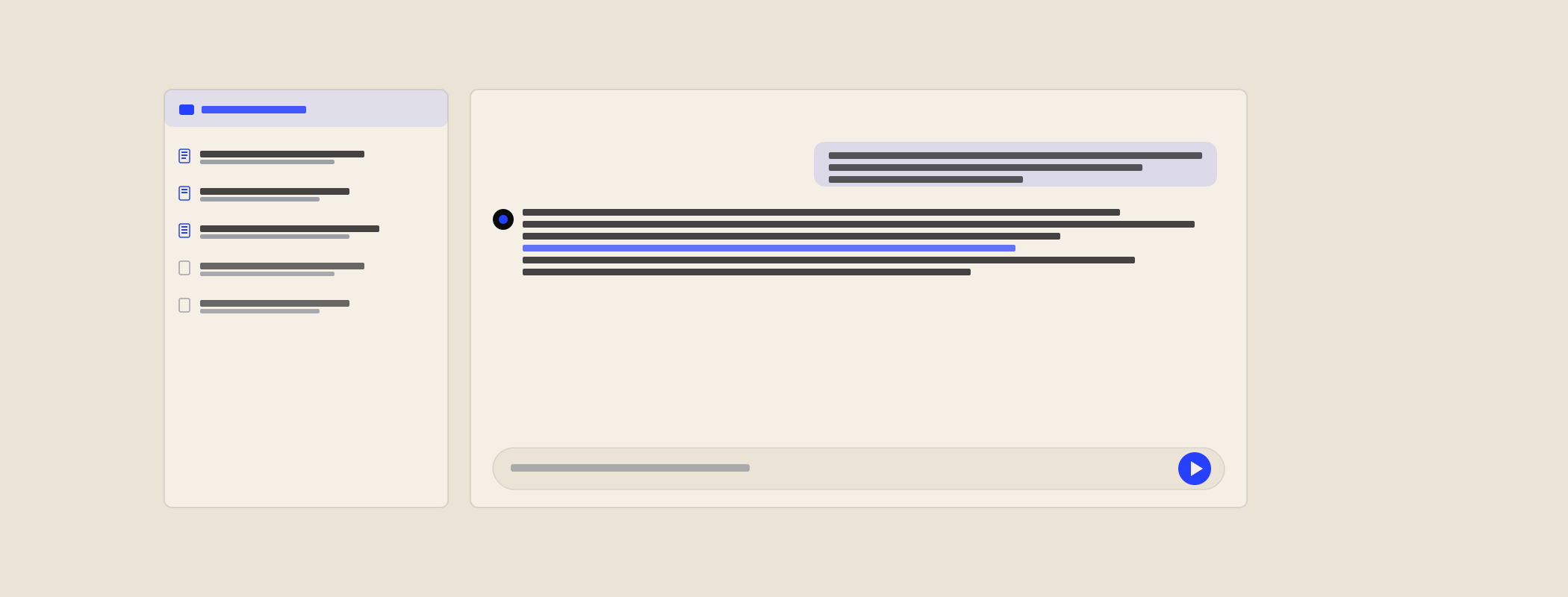
A Claude Project fixes all three. It gives the model persistent brand context, explicit voice instructions, and guardrails on what it cannot invent. Same model, completely different output.
The five files that do most of the work
You don't need a 50-page brand bible. You need five focused files in the Project's knowledge base:
1. Brand voice guide (1–2 pages)
Three sections: How we sound (tone, register, sentence rhythm), What we avoid (specific phrases, jargon, clichés), How we structure (bullets vs prose, headings, length norms). Include 5–10 example sentences for each.
2. ICP & positioning doc (1 page)
Who you serve, who you don't, what their pains are, what they're scrolling past on LinkedIn, what makes them book a call. Specific enough that the model can write to them, not at them.
3. Content style guide (1 page)
How you write blog posts vs LinkedIn vs sales emails. Length expectations. CTA conventions. Heading style. Whether you use serial commas. The boring stuff that creates consistency.
4. Example outputs - good AND bad (2–4 pages)
The highest-leverage file. Include 3–5 examples of your best output and 3–5 examples of what bad output looks like (with annotation: "this is too generic", "this invented a stat", "this used a banned phrase"). Models learn from examples faster than from instructions.
5. Claims & compliance guardrails (1 page)
What the model is allowed to invent vs not. Real customer names: never. Industry statistics: only from listed sources. Product features: only what's in the spec doc. Pricing: never invent.
The system prompt that anchors everything
The Project's system instructions sit at the top of every conversation. Keep them tight - 150–300 words is plenty. Structure:
- Who you are (one sentence)
- Who you write for (one sentence)
- How you sound (3–5 bullets, very specific)
- What you never do (3–5 bullets)
- Output format defaults (when in doubt, do X)
You are the content engine for [Brand]. Reference the
files in this Project before drafting anything.

WHO WE ARE: [one-line elevator pitch]

WHO WE WRITE FOR: [primary persona, one line]

HOW WE SOUND:
- Plain language. Short sentences. No SaaS-bro hype.
- Confident, slightly cheeky, never apologetic.
- Lead with the answer, never with the windup.

NEVER:
- Invent statistics, customer names, or case study numbers.
- Use banned phrases (see brand voice guide file).
- Start a piece with "In today's fast-paced..."

OUTPUT FORMAT: bullets over prose when listing,
short paragraphs when explaining, headings
every 250 words.
What this actually fixes (with examples)
Three real failure modes a Project setup eliminates:
Hallucinated stats
Default output: "73% of B2B buyers now research with AI before contacting sales." (Made up. Sounds plausible. Will get repeated.)
With guardrails: "A meaningful share of B2B buyers now research with AI before contacting sales - exact figures vary by source. [Insert verified stat or remove.]"
Generic openers
Default output: "In today's rapidly evolving digital landscape, businesses must adapt to stay competitive."
With voice guide: "AI Overviews ate 40% of the click-through. Your team noticed. Your CFO has not."
Wrong CTA
Default output: "Schedule a free consultation today!"
With style guide: "If this is the gap on your team, drop me a line. hello@brand.com - direct, no calendar gauntlet."
Same model, same task. The difference is the context.
Common setup mistakes
- Too much instruction, not enough examples. 500-word system prompts perform worse than 200-word prompts paired with good example files. Models learn from imitation.
- Vague voice rules. "Confident and friendly" tells the model nothing. "Short sentences. No clichés. Never start with 'In today's...'" tells it everything.
- Forgetting bad examples. The model learns equally from "do this" and "never do this". Skipping bad examples is leaving half the signal on the table.
- Not updating the Project. Your brand evolves. New service lines, new ICP refinements, new banned phrases. Schedule a quarterly review.
- Letting the team off-Project. A perfectly tuned Project is worthless if your team still uses default Claude.com because it's faster. Make Project access the default, not the option.
Custom GPT equivalent (for OpenAI/ChatGPT teams)
If your team is on ChatGPT Team or Enterprise, the equivalent is a Custom GPT (the GPT Builder). Same logic, slightly different UI:
- Instructions = system prompt
- Knowledge files = the 5 brand files
- Conversation starters = pre-built prompts ("Draft a LinkedIn post", "Write a sales email reply")
- Actions = optional, for connecting to your CRM or CMS
The work transfers directly. If you've built a tight Claude Project, the same files and instructions work in a Custom GPT with minor adjustments.
See it before you build it. There is an interactive version of this on the AI setup page: drag the mess around, watch it refuse to improve, then structure it and see the same model answer properly.
Next step. Build the five files, then test them against your worst recent output. If you would rather have the whole foundation built and handed over working, that is the AI setup work - here is how that runs.