The pillar-and-cluster content model was the SEO playbook of the 2010s. A 5,000-word pillar page, surrounded by 20 short supporting posts, all internally linked. It worked. For 2018 Google. In 2026, AI engines and modern Google don't reward that shape - they reward something that looks more like a web than a hub. Here's the model that's working now, and how to map it out for any B2B niche.
Why the pillar model died
The pillar-and-cluster strategy worked because it gamed two specific 2010s Google signals:
- Comprehensive content - Google rewarded the longest, most comprehensive page on a topic. So you wrote 5,000 words.
- Internal link density - Google used internal links as topic authority signals. So you cross-linked 20 satellite posts back to the pillar.
Both signals still exist. But they're no longer the dominant factor. In 2026, AI engines (and modern Google) parse semantic meaning across pages. They don't need a 5,000-word pillar to know what your site is about - they read the network of related pages and extract the relationships.
Worse, the giant pillar page often hurts you. AI engines extract specific answers to specific queries. A 5,000-word essay buries the answer under a wall of context that needs scrolling. A 1,500-word page that answers the question directly wins the citation.
"AI engines cite specific pages, not site structures. Stop building hubs. Start building webs of strong individual pages."
What a content web actually looks like
Pick any B2B topic. Say, "B2B SEO for SaaS". The pillar model would have you build:
- One 5,000-word pillar: "The complete guide to B2B SEO for SaaS"
- 20 satellites: "How to do keyword research for SaaS", "What is SaaS link building", etc., each 800 words, each linking back to the pillar.
The content web for the same topic looks like this:
- 8–15 medium-depth pages, each 1,200–2,500 words.
- Each page answers a specific, real buyer query (not a keyword chase): "B2B SaaS SEO audit checklist", "How AI Overviews changed SaaS SEO", "Why most SaaS blogs don't rank".
- Each page can rank, get cited, and convert on its own. No "read the full guide for more" needed.
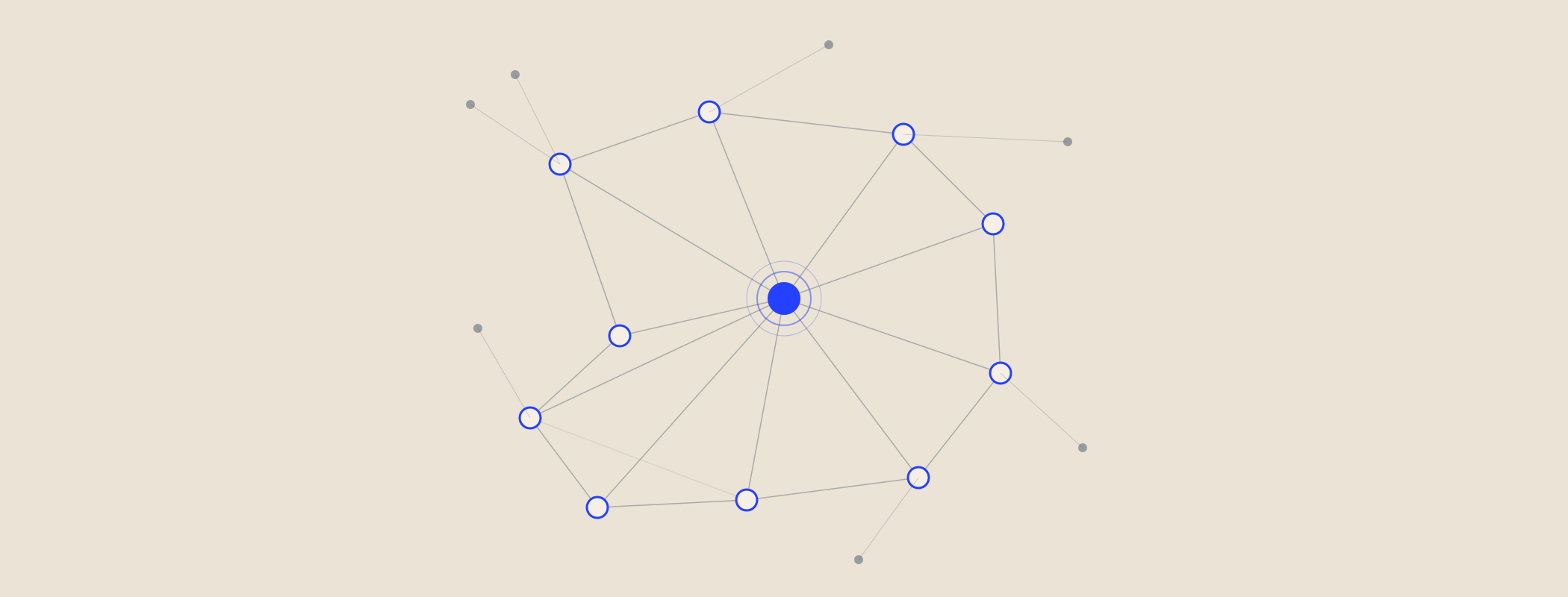
- Internal links are lateral - page A links to pages B, C, D within the same web, where contextually relevant.
- No single "hub" page. The web itself is the hub.
The result: AI engines have multiple strong citation candidates, each precisely answering a different query. Google has multiple ranking pages. And readers get the depth they need without 5,000-word commitment.
How to map a content web for any B2B topic
Five-step process. Takes about 4 hours for a B2B niche:
1. Define the topic and audience
One sentence each. "AEO for B2B SaaS scaleups." "Series A–B marketing leads who need to be cited in AI engines."
2. Brainstorm 30–50 real buyer queries
Use AnswerThePublic, AlsoAsked, Reddit, LinkedIn comments, customer interviews, and ChatGPT itself. The criteria: real questions a real buyer would type. Not keyword phrases.
3. Cluster into 8–15 page topics
Group the queries by intent overlap. Each page should serve 3–5 closely related queries. Anything that doesn't fit becomes a future post or gets dropped.
4. Map the lateral links
For each page, identify the 3–5 other pages in the web it should link to (and that should link to it). This is the web - every node connects to multiple others, not just a central pillar.
5. Sequence the build
Don't try to publish all 15 at once. Sequence by ROI: start with the page that targets the highest-intent, lowest-competition query. Build the web outward over 3–6 months.
Why this works better for AI engines
Three specific reasons content webs outperform pillars for AEO:
- Multiple citation candidates. AI engines pick the most direct answer to a query. A web of 10 medium pages gives the AI 10 candidates. A pillar gives it one big essay with the answer buried somewhere in section 7.
- Semantic relationships. AI engines parse content relationships across pages via internal links and semantic similarity. A web of cross-linked medium pages creates a richer semantic graph than a hub-and-spokes pillar.
- Better entity signals. When 10 pages on your site each cover a sub-topic of [X] in depth, your site becomes the authoritative source on [X] in the AI's view. Better than one giant page covering everything shallowly.
Common mistakes building content webs
- Going too thin. 600-word pages still don't get cited. The minimum for citation-worthy depth is around 1,200 words. Don't fragment a topic into 30 800-word stubs.
- Going too broad. Webs work when the topic is genuinely cohesive. A "B2B marketing" web is too broad. A "B2B AEO for SaaS" web is right.
- Skipping the lateral links. Internal linking is what makes the web a web. Without cross-links, you have 10 orphan pages, not a content network.
- Building all at once. 15 pages launched the same week doesn't perform better than 15 pages sequenced over 4 months. Google and AI engines both prefer a steady cadence.
- Forgetting to update old pillars. If you've already invested in pillar-and-cluster, don't bin the pillars. Repurpose. Split them into 3–5 medium-depth pages within a new web.